
An impression in Google Ads is recorded each time your ad is served to a user, regardless of whether they click, scroll past, or ignore it entirely. That single fact makes impressions the most fundamental metric in any Google Ads account. Before clicks, before conversions, before revenue, there is the impression. Understanding what does impressions mean in Google Ads gives you the baseline for reading every other performance number in your campaigns. Google Ads delivers impressions across the Search Network, Display Network, and YouTube, and each network counts them differently. Impression share, a closely related metric, tells you how many of those available impressions you actually won.
What does impressions mean in Google Ads and how are they counted?
Impressions measure ad visibility, not ad performance. Every time Google serves your ad on a search results page, a website in the Display Network, or a YouTube video, that counts as one impression. The count goes up whether the user reads your ad, glances at it, or never notices it at all.
The counting method differs by network. On the Search Network, an impression is logged the moment your ad appears on a results page. On the Display Network and YouTube, Google also tracks viewable impressions, which apply a stricter standard. A display ad must have at least 50% of its pixels visible on screen for one second or longer to qualify as viewable. For video ads, the threshold rises to two seconds. These standards come from the IAB and MRC, the two bodies that set digital advertising measurement rules.

Pro Tip: Filter your Display campaigns by “Viewable Impressions” instead of raw impressions when reporting brand awareness. Raw impression counts can include ads that loaded below the fold and were never seen.
The gap between raw impressions and viewable impressions can be significant. A banner ad that loads at the bottom of a long webpage may register as an impression even if no user scrolled that far. Viewable impressions give you a more honest picture of actual exposure. For campaigns focused on pay-per-click advertising and brand reach, knowing which type of impression you are measuring changes how you interpret results.
Key differences in impression counting by network:
- Search Network: Impression logged on page load, regardless of ad position
- Display Network: Raw impression on ad delivery; viewable impression requires 50% visibility for 1 second
- YouTube / Video: Viewable impression requires 50% visibility for 2 seconds
- Shopping ads: Impression counted when the product listing appears in results
What does impression share mean in Google Ads?
Impression Share (IS) is the percentage of impressions your ads received out of the total impressions they were eligible to receive. If your ads were eligible for 10,000 impressions and appeared 5,000 times, your impression share is 50%. Eligibility is determined by your targeting settings, not by total Google traffic. A narrow geographic target or a tight keyword list shrinks the eligible pool, which can make your impression share look high even when your total reach is small.
Lost Impression Share breaks down into two categories, and each one points to a different fix. Lost IS (Budget) means your ads stopped showing because your daily budget ran out before the day ended. Lost IS (Rank) means your ads lost auctions because your Ad Rank was too low, which is a function of your bid, Quality Score, and expected impact of ad extensions.
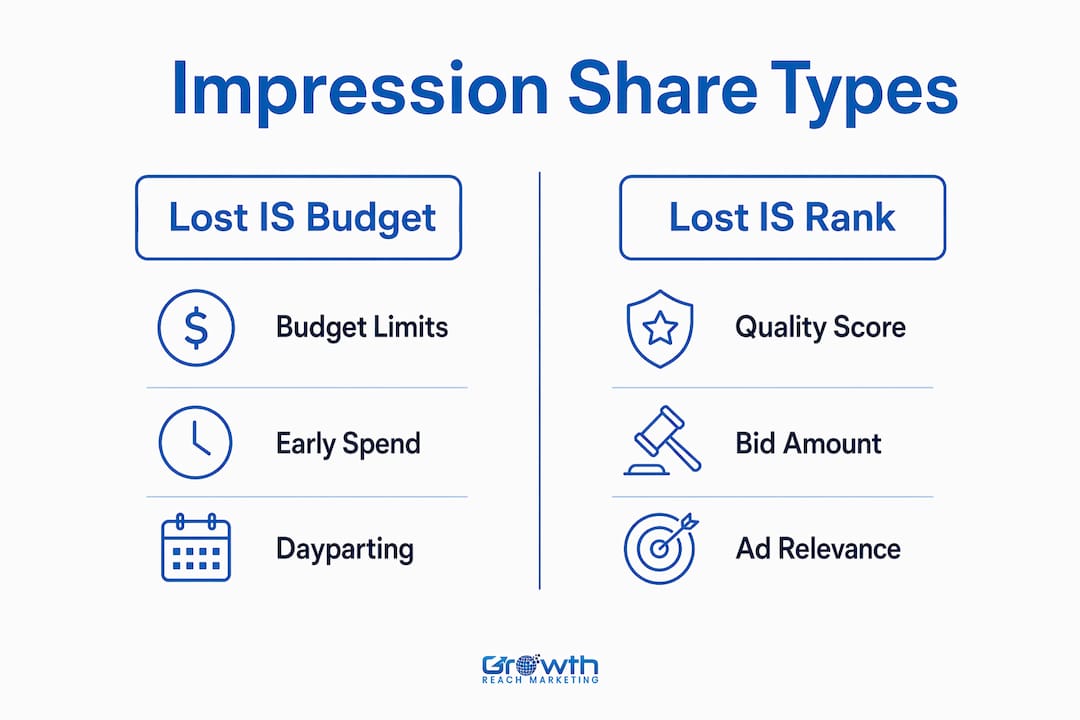
The revenue stakes are real. For every $100 earned from paid search, advertisers may forgo $39 more due to lost impression share. That is not a rounding error. It represents a structural gap in visibility that compounds over time as competitors capture the auctions you are missing.
| Impression share metric | What it tells you | Primary fix |
|---|---|---|
| Impression Share (IS) | % of eligible auctions won | Baseline visibility benchmark |
| Lost IS (Budget) | Impressions missed due to budget cap | Increase daily budget |
| Lost IS (Rank) | Impressions missed due to low Ad Rank | Improve Quality Score or raise bids |
| Search Impression Share | IS specific to Search Network | Refine keyword targeting and bids |
One important nuance: impression share is relative to your configured targeting, not to all Google searches. A campaign targeting one zip code with three keywords will show a high impression share even if the total audience is tiny. Always read impression share alongside absolute impression volume to get the full picture.
Impressions vs. clicks, reach, and engagement: what is the difference?
Impressions and clicks measure completely different things. An impression counts every time your ad appears. A click counts only when a user actively selects your ad. Click-through rate (CTR) is clicks divided by impressions, expressed as a percentage. A campaign with 10,000 impressions and 200 clicks has a 2% CTR.
Reach is a separate concept that often gets confused with impressions. Reach counts unique users who saw your ad. Impressions count total ad displays, including multiple views by the same person. If one user sees your ad five times, that is five impressions but one person in your reach count. Impressions almost always outnumber reach because frequency, the average number of times one person sees your ad, pushes the impression total higher.
Pro Tip: For brand awareness campaigns, watch both impressions and reach together. High impressions with low reach means you are showing the same ad to the same people repeatedly, which can cause ad fatigue and wasted spend.
Engagement metrics go further still. On YouTube, an engagement might be a video view of 30 seconds or longer, a click on a card, or a like. On Display campaigns, engagements include interactions like expanding a rich media ad. Impressions sit at the top of this hierarchy. They are the prerequisite for every other metric. No click, view, or conversion happens without an impression first. That is why ad relevance directly affects how many impressions your ads earn in competitive auctions.
Impressions are the baseline metric for CPM pricing, where advertisers pay per 1,000 impressions. This makes impression volume a direct budget variable, not just a reporting number.
How to use impression data to improve your Google Ads campaigns
Impression data becomes useful when you treat it as a diagnostic tool, not just a vanity metric. Start by checking your impression share weekly. If Lost IS (Budget) is above 20%, your budget is cutting your campaigns short before the day ends. The fix is straightforward: increase the daily budget or tighten targeting to reduce the eligible pool and stretch the budget further.
If Lost IS (Rank) is the bigger problem, the path forward involves improving ad copy quality and landing page relevance to raise your Quality Score. Google calculates Ad Rank using expected CTR, ad relevance, and landing page experience. Improving any of these three factors raises your rank and wins more impressions without necessarily increasing your bid.
Here is a practical sequence for using impression data in campaign reviews:
- Pull the impression share report at the campaign level in Google Ads. Sort by Lost IS (Budget) and Lost IS (Rank) separately.
- Identify campaigns with high Lost IS (Budget). These campaigns are profitable enough to justify more spend. Increase the daily budget incrementally and monitor impression volume.
- Identify campaigns with high Lost IS (Rank). Review Quality Scores at the keyword level. Scores below 5 out of 10 signal weak ad relevance or poor landing page alignment.
- Check impression frequency on Display campaigns. If one user is seeing your ad more than 5 times per week, set a frequency cap to reduce waste and protect brand perception.
- Monitor impression pacing throughout the day. If impressions spike in the morning and drop to zero by afternoon, your budget is exhausting too early. Use ad scheduling to distribute spend more evenly.
- Compare impression share across match types. Broad match keywords often win more impressions but at lower relevance. Phrase and exact match keywords tend to show higher CTR with fewer impressions.
Monitoring impression share helps you separate budget problems from quality problems. These two issues require completely different responses, and conflating them leads to wasted spend. Expert practitioners treat Lost IS (Budget) and Lost IS (Rank) as diagnostic tools that point directly to the right lever to pull.
A common mistake is chasing a 100% impression share. Capturing every eligible impression is rarely cost-efficient. A 70–80% impression share on your highest-converting keywords is a more realistic and profitable target for most campaigns.
Key Takeaways
Impressions are the foundational visibility metric in Google Ads, and impression share is the diagnostic tool that tells you how much of your available market you are actually reaching.
| Point | Details |
|---|---|
| Impressions defined | An impression is recorded each time your ad is served, regardless of clicks or engagement. |
| Viewable impressions matter | Display ads need 50% visibility for 1 second; video ads need 2 seconds to count as viewable. |
| Impression share diagnosis | Split Lost IS by Budget vs. Rank to identify whether to increase spend or improve Quality Score. |
| Impressions vs. clicks | Impressions measure exposure; clicks measure action; reach counts unique users, not total views. |
| Revenue impact | Lost impression share directly reduces revenue opportunity, making it a critical campaign metric. |
Why impression metrics deserve more attention than most advertisers give them
Most advertisers I work with focus almost entirely on clicks and conversions. Impressions get a quick glance, impression share gets ignored, and Lost IS (Rank) is rarely even pulled as a report. That is a significant blind spot.
The competitive environment in Google Ads has tightened considerably. AI-driven bidding strategies like Target CPA and Maximize Conversions adjust bids automatically, but they cannot fix a Quality Score problem or a budget that runs out at noon. Those are structural issues that show up clearly in impression share data and get missed when you only watch conversion reports.
The rise of AI-driven creative and generative search experiences in 2026 makes precise impression monitoring more critical than ever. When Google’s AI reshapes search results pages with generative answers, the available impression inventory for traditional ads shifts. Advertisers who track impression share closely will notice these shifts faster than those who only watch clicks.
One thing I have found consistently: businesses that treat impression share as a weekly diagnostic metric, not a monthly afterthought, catch budget exhaustion and rank problems weeks earlier. That translates directly into fewer missed auctions and more revenue captured. The data is already in your Google Ads account. The question is whether you are reading it.
— Gerard
How Growthreachmarketing approaches Google Ads impression analysis
Growthreachmarketing works with salons, aesthetic clinics, and local service businesses that need their Google Ads to perform, not just run. Impression and impression share data sit at the center of every campaign review we conduct.
When a campaign is losing impressions to budget or rank issues, the fix requires a clear read of the data before touching a single setting. Growthreachmarketing builds that diagnostic process into every account we manage, using impression share reports to identify exactly where visibility is being lost and why. If your campaigns are running but not reaching their full potential, our Google Ads campaign setup and PPC growth services give you a structured path to more impressions, better ad rank, and stronger returns.
FAQ
What is an impression in Google Ads?
An impression is recorded each time your ad is served to a user on Google Search, the Display Network, or YouTube, regardless of whether the user clicks or engages with it.
What does impression share mean in Google Ads?
Impression share is the percentage of eligible impressions your ads received out of the total they could have received, based on your targeting, budget, and Ad Rank.
What is the difference between clicks and impressions?
Impressions count every time your ad appears; clicks count only when a user actively selects your ad. CTR is clicks divided by impressions, expressed as a percentage.
Why is my impression share low?
Low impression share is caused by either a budget that runs out before the day ends (Lost IS Budget) or a low Ad Rank from weak Quality Scores or insufficient bids (Lost IS Rank).
Do impressions cost money in Google Ads?
On Search and most Display campaigns, impressions alone do not cost money. You pay when users click. However, CPM campaigns charge per 1,000 impressions, making impression volume a direct cost driver in those campaign types.