A salon PPC landing page is the single page a person reaches after clicking your Google ad, built around one service and one action: book, call or enquire. Send that click to your homepage and you pay for a visitor who then has to hunt for the treatment they searched for. Send it to a page that repeats the ad’s promise and makes the next step obvious, and the same click is far more likely to become an appointment. This guide is for owners and managers of salons, beauty clinics, aesthetic clinics and med spas in Ireland who run, or plan to run, paid search.
TL;DR
- Build one landing page per service or ad group, not one page for everything. Google says the page should closely match the ad and its keywords and mirror its call to action.
- Put the service, the location, the price guidance and one booking or call button above the fold, before any scrolling.
- Design for the phone first: fast loading, a tap-to-call number and short forms.
- If the page uses tracking or collects enquiries, Irish rules require clear information and consent before non-essential cookies fire.
- Track calls, form enquiries and completed bookings as separate conversions, then change one element at a time.
Table of Contents
- Why a landing page is not your homepage
- Match the page to the ad, the search and the service
- What goes on the page
- Make it work on a phone
- Build trust fast
- Privacy and consent on an Irish landing page
- Measure it properly, then test one thing at a time
- Our perspective
- Where we come in
- FAQ
- Sources
Why a landing page is not your homepage
Google describes the landing page as the place someone arrives after clicking your ad, and says it plays a big part in turning clicks into customers. Your homepage has a different job. It serves existing clients checking opening hours, new visitors comparing everything you offer, job applicants and suppliers. Each of those choices is a way for a paid visitor to wander off.
A landing page does the opposite. It has one audience (someone who just searched for a specific treatment), one promise (the one in your ad) and one action. Think of a person who typed “lash lift Cork”, clicked, and lands on a page about your full range of beauty services. They have to find lashes, work out whether you are in their area and guess how to book. Many will go back and click the next result, and you have paid for that click.
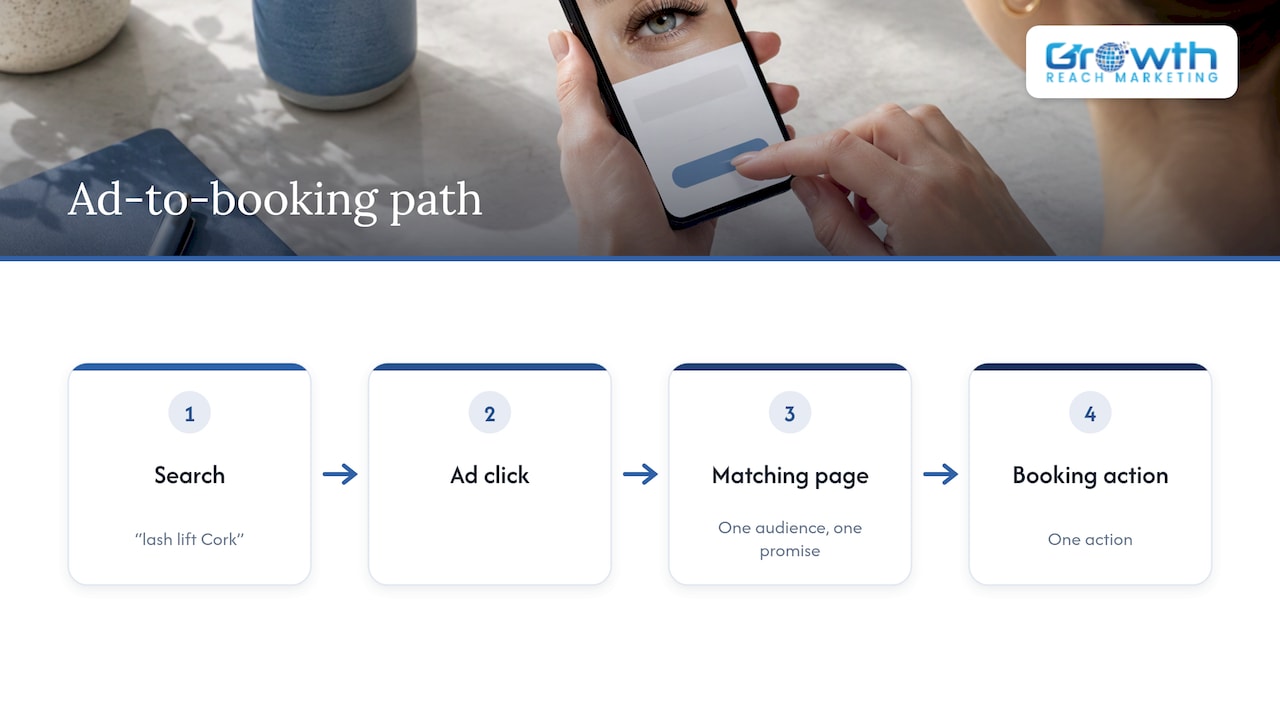
The practical rule: the page exists for the ad, and the ad exists for one treatment. Everything on the page either supports that treatment or goes.
Match the page to the ad, the search and the service
The most common landing page failure in salon accounts is a mismatch. The ad says “Hydrafacial from a qualified therapist” and the page opens with a generic welcome and a menu of twenty services. Google’s guidance is direct on this point: group keywords by theme or service, tailor the ad to that theme, and send people to a page that matches both.
In practice, that gives you a simple structure:
| Ad group | Typical searches | Landing page headline |
|---|---|---|
| Balayage | balayage near me, balayage Galway | Balayage in Galway, with a consultation first |
| Anti-wrinkle consultation | anti-wrinkle treatment Dublin | Anti-wrinkle consultations in Dublin 2 |
| Gel nails | gel nails Limerick | Gel nails in Limerick, book online |
| Bridal hair | wedding hair trial Kildare | Bridal hair trials in Kildare |
Three habits keep this working:
- Repeat the words searchers used. If your ad group targets “balayage”, the headline says balayage, not “colour services”.
- Mirror the call to action. If the ad says “Book a consultation”, the button says the same, not “Contact us”.
- Review the search terms that trigger your ads. Google’s reporting shows which searches led to impressions, which lets you check whether those searches, your headlines and your page still line up. Add irrelevant searches as negatives and split out any service that deserves its own page.
This ties directly to keyword choice. If you want the thinking behind grouping services, our piece on why salons need a keyword strategy covers it, and the Google Ads best practices for salons shows how campaigns are structured around bookings.
For multi-area businesses, a page per location can work when each page is genuinely about that area. We look at when that pays off in salon service area pages.
What goes on the page
A good salon landing page is short enough to read in under a minute and complete enough that nobody needs to leave to find a basic answer. Here is the order that works for most treatments.
Above the fold
The top of the page, before anyone scrolls, should answer four questions: what is this, is it for me, where is it, and how do I book.
- A service-specific headline that echoes the ad.
- One line of benefit, written for the client, not the treatment menu. “Soft, lived-in colour that grows out gracefully” beats “Our balayage service”.
- The location, as a town or area name and ideally a short address line.
- One primary button, such as Book now or Request a consultation, plus a tap-to-call number for phone users.
Below the fold
- Price guidance. “From” pricing or a range, in euro, filters out the wrong enquiries and builds trust. For medical aesthetics, a consultation fee or what the consultation includes does the same job.
- Who does the treatment. The therapist or practitioner’s name, qualifications and years of experience. People book people.
- Proof. A few real client reviews for that specific treatment, and before-and-after photos where you hold the client’s permission and the treatment type allows it.
- What to expect. Duration, aftercare, how to prepare. This answers the questions that otherwise become cancellations.
- Short FAQs. Three to five, on the doubts that stop people booking: pain, downtime, deposit, cancellation policy.
- A repeat of the button at the bottom, so nobody has to scroll back up.
What to leave off
Remove the full site navigation, social media icons that lead away, a blog feed and unrelated offers. A small logo linking to your homepage is enough. If the page is for lash lifts, it should not also advertise gift vouchers and a hair removal package.
Med spas and aesthetic clinics have extra considerations around claims, consultations and how treatments are described. We cover them in med spa landing pages and Irish rules.
Make it work on a phone
Most salon searches happen on a phone, often while the person is out and about. Google’s advice for mobile advertisers is to use mobile URLs and make phone numbers clickable, so one tap starts a call. That single change matters for salons, where many people would rather ring than fill in a form.
Speed is the other half. Google’s mobile guidance says pages should load quickly and be easy to navigate, and reports that nearly half of visitors leave a mobile site that takes more than three seconds to load. For a salon page, the usual causes are oversized photos, auto-playing video, and booking widgets that load slowly.
A quick mobile checklist:
- Compress every image before upload, and use a few strong photos rather than a gallery of twenty.
- Keep the form to the essentials: name, phone or email, the treatment and a preferred time.
- Use buttons big enough for a thumb, with space around them.
- Put the call button where it stays visible as the person scrolls.
- Open the page on your own phone on mobile data, not your office wifi, and try to book in under a minute.
If the booking step itself leaks clients, the fix sits after the click. Our guide to booking conversion optimization goes through where people drop out between interest and a confirmed appointment.
Build trust fast
A stranger deciding whether to put their hair, skin or face in your hands needs reassurance quickly. The elements that do this best are concrete rather than decorative:
- Reviews that name the treatment and the result.
- Your Google rating, shown honestly.
- A photo of the actual practitioner and the actual premises, not stock images.
- Clear cancellation and deposit terms.
- Registration or insurance details where your profession requires them.
For aesthetic treatments, a consultation-first offer is often a lower-pressure first step than a direct booking, and it fits how clients think about injectables and skin treatments.
Privacy and consent on an Irish landing page
If your page collects names and phone numbers, or uses analytics and advertising pixels, Irish data protection and ePrivacy rules apply. The Data Protection Commission’s guidance on cookies and tracking says consent is required before non-exempt cookies or tracking technologies store or read information on a visitor’s device. Only strictly necessary and certain communications cookies are exempt.
In practice, for your landing page:
- Explain in plain language what each tracking tool does and who receives the data.
- Do not fire advertising or analytics tags until the visitor has actively agreed.
- Make rejecting as easy as accepting. Pre-ticked boxes, scrolling and inactivity do not count as consent.
- Let people withdraw consent as easily as they gave it.
- Add a short privacy notice near your enquiry form saying what you will do with the details and how to contact you.
If you handle health-related information in a clinic form, such as medical history, take particular care about what you ask for before a consultation and where it is stored. For specific legal questions, speak to a solicitor or the Data Protection Commission.
Consent affects measurement, too. If visitors decline tracking, your reported conversions will be lower than the real number of bookings, so keep a record of how new clients say they found you.
Measure it properly, then test one thing at a time
A landing page is never finished. The aim is to learn which version books more clients per euro spent.
Decide what counts as a conversion
For a salon, a conversion is not a page view. It is one of three actions:
- A call from the page (tracked via the click-to-call button or a call ad).
- A form enquiry.
- A completed booking in your system.
Track them separately, because a booking is worth far more than a casual enquiry. Our guide to Google Ads conversion actions for salons explains how to set these up, and the 60 second rule for call ads covers filtering out unwanted calls.
Know which numbers to read
Google’s landing page reporting includes clicks, conversions, conversion rate, cost per conversion, the share of mobile-friendly clicks and a speed score for each page. For a salon owner, the useful reading is:
- Conversion rate per page: which treatment page turns clicks into actions.
- Cost per conversion: what a call or enquiry really costs you.
- Mobile-friendly clicks and speed score: whether the phone experience is dragging results down.
Then compare cost per conversion with what a client is worth. A balayage client who rebooks every few months can justify a higher acquisition cost than a one-off patch test. The Google Ads budget guide for salons helps set that ceiling.
Test in a sensible order
Change one thing at a time, and let a test run until it has enough clicks to mean something. A reasonable order:
- The headline (service wording versus benefit wording).
- The button text and position.
- Price guidance shown or hidden.
- The main photo (practitioner versus result).
- Form length.
With 130 monthly searches for this topic and small ad budgets typical of single-site salons, expect tests to take weeks, not days. Do not read a result from a handful of clicks.
Our perspective
Most salon owners we speak to are not short of clicks, they are short of a page that finishes the job the ad started. The ad earns attention for one treatment, and the landing page has a few seconds to confirm it: right service, right place, easy to book.
That is why we build landing pages for beauty and aesthetics as part of a wider system rather than as a design exercise. The ad, the page, the call tracking, the follow-up of an enquiry and the reporting have to agree with each other. Our approach is tailored to salons, clinics and med spas, with Irish-based service and an emphasis on ethical, data-driven results.
If you take one thing from this article, make it this: one treatment, one page, one action, and measure bookings rather than visits.
Gerard
Where we come in
Growth Reach Marketing works with salons, aesthetic clinics and med spas on Google Ads, Facebook and Instagram ads, SEO and AI search visibility, lead generation and conversion optimization, and AI enquiry handling, follow-ups and booking automation. A landing page is one part of that chain, and it performs best when the ads, the tracking and the follow-up are planned together.
You can see the full list on our services page, or read how lead generation for beauty clinics fits together.
FAQ
How many landing pages does a salon need?
One per service you advertise is a good rule. A salon running ads for balayage, gel nails and bridal hair should have three pages, each matched to its own ad group. Start with the treatment that earns the most margin and add pages as you learn.
Can I send Google Ads traffic to my homepage?
You can, but a page built around one service usually fits the ad better. Google advises matching the page closely to the ad and keywords, and a homepage covers many services at once. A dedicated page keeps the visitor focused on the one action you paid for.
Should the page show prices?
Price guidance, such as a “from” price in euro or a consultation fee, helps people decide before they enquire, so enquiries are better qualified. For treatments priced after a consultation, say what the consultation costs and what it includes.
Do I need a cookie banner on a landing page?
If the page uses advertising or analytics cookies or similar tracking, Irish rules require consent before they run, with a clear reject option, as set out in the Data Protection Commission’s guidance. Purely necessary cookies are exempt. Your solicitor or the DPC can confirm your specific setup.
How do I know if the page is working?
Track calls, form enquiries and completed bookings as separate conversions, then look at conversion rate and cost per conversion for each page. Compare those with what a new client is worth to you over time.
Sources
- Optimise your ads and landing pages, Google Ads Help
- Connect with mobile users, Google Ads Help
- Optimize your website for mobile, Google Ads Help
- landing_page_view, Google Ads API
- Guidance Note: Cookies and other tracking technologies, Data Protection Commission