
Google Ads for medical aesthetics is a pay-per-click advertising system that places your clinic’s ads at the top of Google search results when potential clients search for treatments like Botox, CoolSculpting, or laser skin resurfacing. Unlike organic SEO, which takes months to build, Google Ads generates qualified leads quickly by targeting people who are already ready to book. For medical spa owners and clinic marketing professionals, understanding what Google Ads for medical aesthetics actually does, and how to run it correctly, is the difference between a profitable campaign and wasted budget.
What is Google Ads for medical aesthetics and how does it work?
Google Ads is a paid search platform that shows your clinic’s ads to people actively searching for the treatments you offer. The industry term for this is pay-per-click advertising, or PPC. You bid on keywords, write ads, and pay only when someone clicks. The result is immediate patient demand capture at the exact moment a person is looking for your service.
Medical aesthetics advertising on Google works differently from social media ads. On Facebook or Instagram, you interrupt someone scrolling through their feed. On Google, you appear when someone types “lip filler near me” or “best med spa in Austin.” That search intent is far more valuable. Google Ads outperforms Facebook in capturing immediate bookings because the person is already in buying mode.

The platform operates through a real-time auction. Every time a relevant search happens, Google evaluates your bid, your ad quality, and your landing page to decide where your ad appears. Higher quality ads with relevant landing pages can outrank competitors even with lower bids. That means ad relevance and page quality matter as much as budget.
How does Google Ads target potential patients in medical aesthetics?
Keyword targeting is the core of any PPC campaign for medical aesthetics. The most effective approach uses specific, treatment-focused keywords rather than broad terms.
- High-intent local keywords like “Botox clinic Chicago” or “CoolSculpting near me” attract clients ready to book, not just browse.
- Treatment-specific keywords such as “dermal fillers,” “laser hair removal,” and “chemical peel treatment” capture patients researching specific procedures.
- Negative keywords filter out irrelevant traffic. Adding terms like “DIY,” “at home,” or “training course” prevents your budget from being spent on non-patient searches.
- Geographic targeting limits your ads to a defined radius around your clinic. A med spa in Dallas has no reason to pay for clicks from Houston.
The difference between Google Ads and Facebook for clinics comes down to intent. Facebook builds awareness among people who may eventually want a treatment. Google captures people who want one right now. For clinics with limited budgets, Google Ads delivers faster, more measurable returns on patient acquisition.
Pro Tip: Run separate ad groups for each treatment category. A person searching “Botox” and a person searching “microneedling” have different needs. Mixing them into one ad group dilutes your message and hurts your Quality Score.
What are the best practices for Google Ads campaigns in aesthetics clinics?
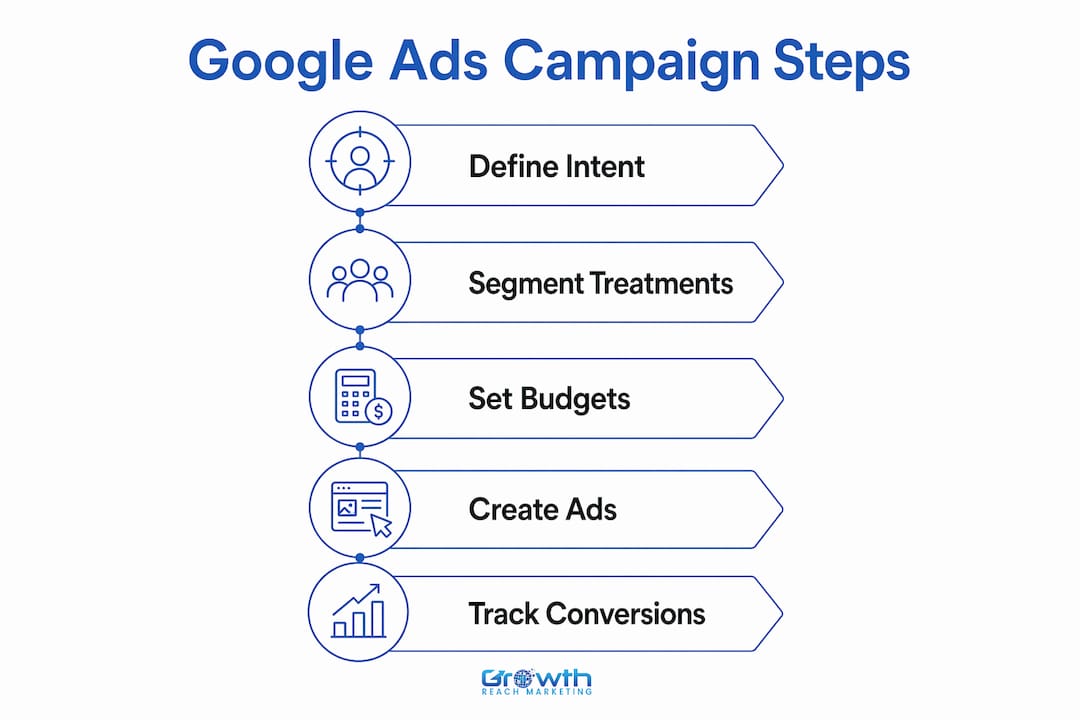
Effective medical spa online marketing through Google Ads requires a structured approach. The following five practices separate profitable campaigns from ones that drain budget.
-
Use Smart Bidding with enough conversion data. Google recommends 30 or more conversions per month per campaign for its AI bidding algorithms to work effectively. Target CPA (tCPA) and Target ROAS (tROAS) bidding strategies rely on conversion history. Without enough data, the AI cannot optimize bids accurately.
-
Organize campaigns by treatment category. Segmenting campaigns by injectables, body contouring, and laser treatments gives you clearer performance data and more precise budget control. A single campaign covering all services makes it nearly impossible to know which treatment is driving results.
-
Build dedicated landing pages for each treatment. Sending paid traffic to your general homepage is one of the most common and costly mistakes in digital marketing for aesthetics. Clinics using fast, offer-specific landing pages see significantly better patient acquisition rates. Each page should match the search intent of the ad that triggered it.
-
Avoid trademarked terms in ad copy. Google’s healthcare advertising policies are strict. Using brand names like “Botox” directly in ad headlines can trigger account suspension. Use neutral language in ads and reserve specific product names for your landing pages.
-
Use Responsive Search Ads with diverse assets. High-quality, diverse ad assets with Responsive Search Ads give Google’s algorithm more combinations to test. More variety means better ad relevance and higher click-through rates over time.
Pro Tip: Consolidate your ad groups. The old approach of one keyword per ad group is obsolete. Consolidated campaigns with 5–15 tightly themed keywords give Google’s AI enough data density to optimize bids effectively in 2026.
| Approach | Outcome |
|---|---|
| One campaign for all services | Unclear data, poor budget control |
| Campaigns split by treatment | Clear ROI per service, better bidding |
| Generic homepage as landing page | Low conversion rates, wasted spend |
| Dedicated treatment landing page | Higher bookings, better Quality Score |
| Manual CPC with many ad groups | Slow optimization, limited AI efficiency |
| Smart Bidding with consolidated groups | Faster AI learning, lower cost per acquisition |
What are the common pitfalls and compliance risks in aesthetics Google Ads?
Medical aesthetics advertising carries compliance risks that most general PPC campaigns never face. Getting these wrong does not just hurt performance. It can get your account suspended.
- Trademarked terms in ad copy are the most common cause of account suspension. Google’s sensitive healthcare content policies flag accounts that repeatedly use brand names like Botox or Juvederm in ad headlines. Use descriptive language instead: “anti-wrinkle injections” or “dermal filler treatment.”
- Sending paid traffic to a general homepage destroys conversion rates. A person who clicked an ad for “laser skin resurfacing” and lands on a homepage with 12 different services will leave immediately. Dedicated landing pages matched to search intent are not optional. They are the foundation of a profitable campaign.
- Skipping conversion tracking is a budget killer. Campaigns without proper tracking lose all AI optimization advantages and give you no visibility into actual ROI.
- Ignoring regional policy differences creates compliance gaps. Google’s healthcare ad policies vary by country and sometimes by state. What is allowed in one market may trigger a policy violation in another.
“Without conversion tracking, you are flying blind. You cannot optimize what you cannot measure, and Google’s AI cannot help you if it does not know what a successful outcome looks like.”
Clinics that avoid wasting paid ad spend consistently do two things: they track real outcomes, and they keep ad copy compliant from day one.
How do you measure and optimize Google Ads for medical aesthetics?
Measuring success in PPC for medical aesthetics means tracking booked appointments, not just clicks. Clicks are a vanity metric. Cost per acquisition (CPA) is the number that tells you whether your campaign is profitable.
- Set up conversion tracking for appointments, calls, and form completions. Tracking actual booked appointments rather than page visits gives Google’s AI the signal it needs to find more patients like your best converters.
- Track offline conversions where possible. Patients often click an ad, call the clinic, and book over the phone. Importing those call outcomes back into Google Ads closes the loop between ad spend and real revenue.
- Monitor CPA by treatment category. A laser treatment campaign may have a higher CPA than an injectable campaign, but the lifetime value of that patient may justify it. Evaluate campaigns in context, not in isolation.
- Review search term reports weekly. Actual search queries often reveal new negative keywords to add and new high-intent terms to bid on. This is where budget leaks are found and fixed.
Pro Tip: Use Google Ads conversion actions to track phone calls that last longer than 60 seconds. Short calls are often wrong numbers. Long calls are real patient inquiries. The conversion actions guide from Growthreachmarketing walks through the setup step by step.
Continuous optimization also means testing landing pages. A page with a clear headline, a single call to action, and fast load time will outperform a cluttered page every time. Understanding the difference between a landing page and a website is foundational for any clinic running paid ads.
Key Takeaways
Google Ads for medical aesthetics works when campaigns are built around patient intent, organized by treatment, tracked to real bookings, and kept compliant with Google’s healthcare policies.
| Point | Details |
|---|---|
| Target intent, not just keywords | Use local, treatment-specific keywords to reach patients ready to book, not just browse. |
| Organize by treatment category | Split campaigns by injectables, laser, and body contouring for clearer data and better budget control. |
| Use dedicated landing pages | Match every ad to a fast, treatment-specific page to improve conversions and Quality Score. |
| Track real conversions | Measure booked appointments and calls, not clicks, to give Google’s AI accurate optimization signals. |
| Stay compliant from day one | Avoid trademarked terms in ad copy to prevent account suspension under Google’s healthcare policies. |
What I have learned running Google Ads for aesthetics clinics
Most clinics that struggle with Google Ads are not losing because of their budget. They are losing because of their setup. I have seen accounts spending thousands of dollars a month sending traffic to a homepage with no clear call to action, no treatment-specific messaging, and no conversion tracking. The ads were fine. Everything behind the click was broken.
The shift I have seen work consistently is treating Google Ads as one part of a broader system, not a standalone fix. Clinics that pair Google Ads with a solid SEO strategy for aesthetic clinics see compounding returns. Paid search fills the pipeline immediately. SEO builds authority over time. Together, they cover both short-term bookings and long-term visibility.
The other thing most articles will not tell you: Google’s AI is genuinely good now, but it needs the right inputs. Giving it vague goals, no conversion data, and a homepage to send traffic to is like hiring a great employee and giving them no job description. The AI cannot save a structurally broken campaign. Your job as a marketer is to give it clean data, clear goals, and quality landing pages. Then let it work.
Patience matters too. Smart Bidding strategies need time to accumulate conversion data before they perform at their best. Clinics that pull the plug after two weeks never see what the campaign could have become. Budget for at least 60–90 days before drawing conclusions.
— Gerard
How Growthreachmarketing helps aesthetic clinics get more from Google Ads
Running compliant, high-performing Google Ads campaigns in the medical aesthetics space requires more than a basic PPC setup. It requires knowledge of healthcare ad policies, treatment-specific campaign structures, and conversion tracking that ties ad spend to real booked appointments.
Growthreachmarketing specializes in Google Ads for aesthetic clinics, building campaigns that stay compliant, attract high-intent patients, and generate measurable ROI. From campaign architecture to landing page strategy, every element is built around what actually drives bookings. If your clinic is ready to stop guessing and start growing, Growthreachmarketing’s team is ready to help you build a system that works.
FAQ
What is Google Ads for medical aesthetics?
Google Ads for medical aesthetics is a PPC advertising system that places clinic ads at the top of Google search results when potential clients search for treatments like fillers, laser therapy, or body contouring. It delivers immediate visibility to high-intent patients, unlike SEO which takes months to produce results.
How much does Google Ads cost for a medical aesthetics clinic?
The cost varies by market, treatment category, and competition level. Costs are not publicly fixed by Google. Budget requirements depend on your target CPA and the volume of conversions needed to activate Smart Bidding effectively.
Why do Google Ads campaigns get suspended for aesthetics clinics?
Account suspensions most often occur when ad copy includes trademarked terms like Botox or Juvederm, which violates Google’s healthcare advertising policies. Using neutral, descriptive language in ads and reserving brand names for landing pages prevents this issue.
What conversions should I track in a medical aesthetics Google Ads campaign?
Track booked appointments, phone calls longer than 60 seconds, and completed contact forms. Tracking actual patient bookings rather than clicks gives Google’s AI the data it needs to find and target your best potential clients.
Should I use Google Ads or Facebook ads for my aesthetics clinic?
Use both, but for different goals. Google Ads captures patients actively searching for treatments and drives direct bookings. Facebook builds brand awareness among people who may not yet be searching. For immediate patient acquisition, Google Ads delivers faster and more measurable results.
Recommended
- Why Aesthetic Clinics Need an SEO Strategy in 2026 – Growth Reach Marketing
- Why Aesthetic Clinics Lose Paid Ad Spend in 2026 – Growth Reach Marketing
- Programmatic Advertising for Clinics: 2026 Guide – Growth Reach Marketing
- Types of Aesthetic Clinic Retargeting Ads Explained – Growth Reach Marketing