A salon online review strategy is a defined system for generating, managing, and responding to client feedback across platforms like Google, Facebook, Booksy, and Yelp. The industry term is online reputation management, and for salons, it directly controls how new clients find you and whether they book. Mirror-moment review requests convert at 20–30%, while delayed digital requests convert at only 8–12%. That gap represents real chairs filled or empty. The tactics below give you concrete, research-backed examples to close it.
1. salon online review strategy examples: start with the mirror moment
The single highest-converting review request happens at the mirror, the moment a client sees their finished look and their satisfaction peaks. Professional Beauty Association research from 2025 confirms this window converts at 20–30%. That is two to three times better than any follow-up text or email.
Train every stylist to recognize this moment and use a simple, natural ask:
- “I’m so glad you love it. Would you mind leaving us a quick Google review? It really helps us out.”
- “If you’re happy with your color today, a review on Google takes less than a minute and means the world to us.”
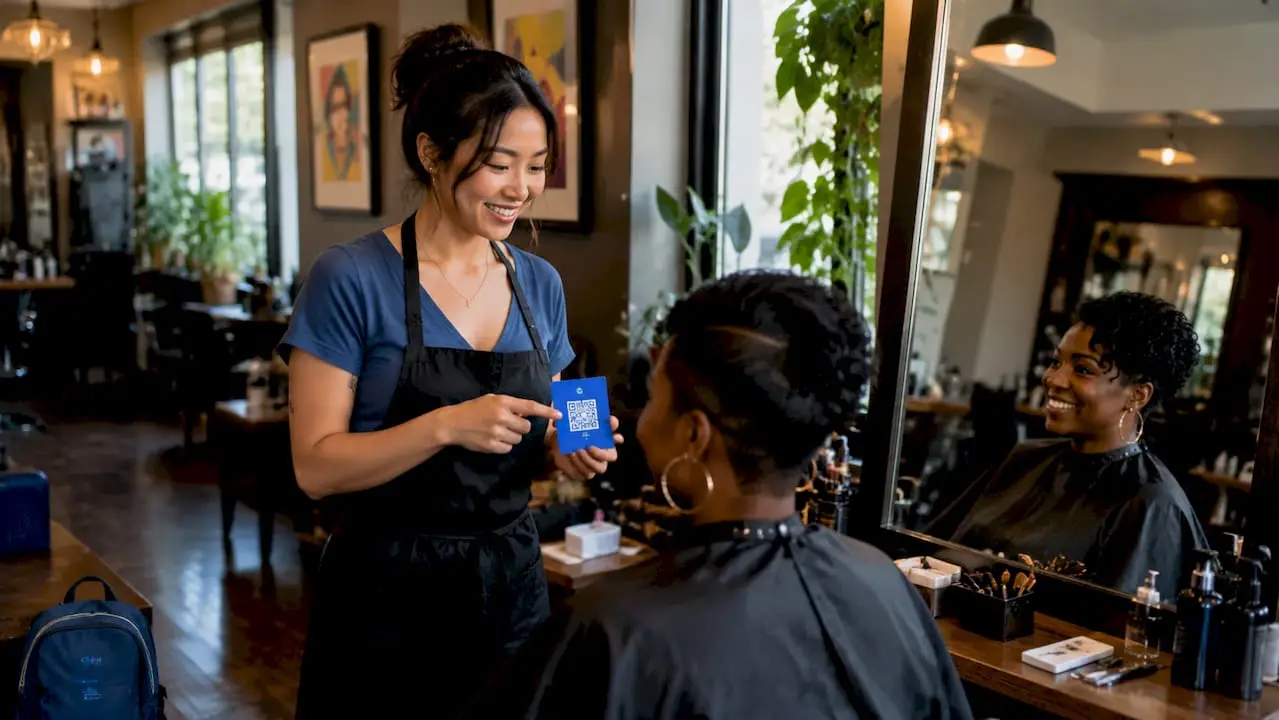
- Post a QR code at the checkout mirror so clients can scan and review before they leave.
The key is timing. Ask too early and the client hasn’t seen the result. Ask at the front desk during payment and the emotional peak has already passed.
Pro Tip: Place a small card near the mirror with a QR code linking directly to your Google review page. Clients who scan it while still in the chair convert at a much higher rate than those who receive a follow-up text hours later.
2. follow up digitally within 3–4 hours of the appointment
The two-tiered review ask combines an in-person mirror moment with an automated digital follow-up for maximum conversion. Not every client will act at the mirror, but many will respond to a well-timed text.

Send your follow-up SMS 3–4 hours after the appointment. This window captures clients while the experience is still fresh and before the day moves on. Keep the message short, warm, and direct. Something like: “Hi [Name], it was great seeing you today! If you have a moment, we’d love a Google review: [short link]. It only takes a minute.”
Automated tools like DaySmart and Regulr can trigger these messages based on appointment completion. That removes the burden from your front desk staff and keeps the timing consistent. Automated review requests combined with personal stylist asks produce higher-quality and more frequent reviews, especially on Google, which directly affects your local SEO ranking.
3. remove every friction point between client and review
Frictionless review submission is the single biggest driver of review volume increases in salons. If a client has to search for your business, log into Google, and navigate to the review tab, most won’t bother. Every extra step cuts your conversion rate.
Common friction points and their fixes:
- Long URLs: Replace with a shortened direct link using tools like Bitly or a custom short domain.
- No QR code: Add QR codes at the mirror, checkout counter, and on appointment reminder cards.
- Vague ask: Give clients a specific platform. “Leave us a Google review” outperforms “leave us a review somewhere.”
- No script: Front desk staff who don’t know what to say often say nothing. Write a two-sentence script and post it at the desk.
- Buried request: Don’t bury the review ask inside a long email. Make it the only call to action in your follow-up message.
Pro Tip: Use your salon booking software, such as Booksy or DaySmart, to embed a direct review link in every post-appointment confirmation message. Clients who click from a confirmation message are already in a positive mindset.
4. how to respond to positive salon reviews
Response tone matters more to potential clients than the review itself. A warm, specific reply to a five-star review signals that your salon is attentive and personal. Generic responses like “Thanks for your feedback!” do the opposite.
Effective positive review responses include the client’s name, the specific service, and the stylist’s name when appropriate. Here is a real-world example:
“Thank you so much, Sarah! We’re thrilled you loved your balayage with Jessica. She puts so much care into every color appointment, and it means a lot to hear that. We can’t wait to see you at your next visit!”
This response does three things. It personalizes the interaction, it highlights a specific stylist and service, and it reinforces the booking cycle by mentioning the next visit. Potential clients reading this response see a salon that knows its clients by name.
Respond to every positive review within 24 hours. Delayed responses feel like an afterthought and reduce the trust signal for new visitors reading your profile.
5. how to handle negative salon reviews without making it worse
The salon owner should respond to negative reviews, not the individual stylist. This keeps the tone professional and prevents the situation from escalating into a public back-and-forth.
Follow this protocol for every negative review:
- Acknowledge the client’s experience without dismissing it.
- Apologize for the fact that they left unhappy, even if the details are disputed.
- Move the conversation offline with a direct phone number or email.
- Never argue, explain at length, or name other staff members in the response.
A strong negative review response sounds like this: “We’re sorry to hear your visit didn’t meet your expectations, [Name]. This isn’t the experience we want for any of our clients. Please reach out to us directly at [phone/email] so we can make this right.”
Private feedback loops with response SLAs of 15–30 minutes in-salon and 2 hours post-visit help catch unhappy clients before they post publicly. Tools like Tapsy build this kind of alert system into their platform.
6. use reviews internally to motivate your team
Reading stylist-named reviews at team meetings is one of the most underused tools in salon management. Positive reviews that mention a specific stylist by name are powerful morale boosters. They also set a visible standard for the rest of the team.
Here is a practical system for using reviews internally:
- Track reviews by stylist each week using a shared spreadsheet or your salon software dashboard.
- Read standout reviews aloud at your weekly team meeting, naming the stylist.
- Post printed review highlights in your staff break room or on a digital display board.
- Create a monthly “Most Reviewed Stylist” recognition, even if the reward is just public acknowledgment.
- Use reviews that mention specific techniques or services as coaching examples in training sessions.
Stylist-level review tracking publicly celebrated increases engagement and motivates the whole team to ask for reviews. The competitive element is natural and productive. Stylists who see their colleagues recognized by name will start asking clients more consistently.
Pro Tip: Share positive reviews on your salon’s Instagram Stories or Facebook page, tagging the stylist when appropriate. This doubles as social proof marketing and gives your team public recognition that builds loyalty.
7. which platforms and tools should salons prioritize?
The right platform mix depends on where your clients already search and book. Google is non-negotiable for every salon because it directly affects local SEO and Google Maps visibility. Facebook and Yelp remain relevant for specific demographics. Booksy is the strongest option for salons whose clients book through a dedicated beauty app.
| Platform / Tool | Best For | Key Feature | Integration |
|---|---|---|---|
| Google Business Profile | Local SEO, new client discovery | Reviews appear in Maps and Search | Works with most booking tools |
| Community engagement, referrals | Reviews visible to friends of reviewers | Connects with Meta ad campaigns | |
| Yelp | Urban markets, high-intent searches | Strong review filtering system | Limited booking integrations |
| Booksy | In-app booking and reviews | Reviews tied directly to appointments | Native to Booksy platform |
| Regulr | Automated review management | Review requests, tracking, analytics | Integrates with salon POS systems |
| DaySmart | All-in-one salon software | Automated post-appointment review requests | Built into scheduling and POS |
| Tapsy | Preventing negative public reviews | Private feedback alerts before public posting | Standalone reputation tool |
Sharing recent positive reviews on social media, your website, and inside the salon reinforces credibility and attracts new clients. The platforms above each serve a different part of that distribution chain. Prioritize Google first, then layer in the others based on where your clients spend time.
Key takeaways
A salon’s online reputation is built or lost in the moments right after a great service. The most effective review strategy combines a timely in-person ask with automated digital follow-ups and personalized responses that show potential clients your salon genuinely cares.
| Point | Details |
|---|---|
| Time your ask correctly | Mirror-moment requests convert at 20–30%, far above any digital follow-up alone. |
| Remove friction first | Direct links and QR codes are the fastest way to increase review volume. |
| Respond within 24 hours | Personalized responses with client names and service details build trust for new visitors. |
| Owner handles negatives | Salon owners should respond to negative reviews to keep tone professional and prevent escalation. |
| Use reviews internally | Tracking and sharing stylist-named reviews at team meetings drives consistent service quality. |
Why the mirror moment changes everything
I’ve worked with enough salon owners to know that most of them treat reviews as something that just happens, not something they build. That’s the gap. The salons that consistently pull four and five-star ratings aren’t luckier. They’ve built a repeatable system around a single insight: the best time to ask is when the client is already happy.
The mirror moment isn’t a gimmick. It’s the recognition that emotion drives action, and that a client staring at a result they love is the most motivated they will ever be to tell someone about it. Every hour that passes after that moment reduces the chance they’ll follow through.
What I see go wrong most often is over-reliance on automation without any personal touch. Automated texts are useful, but they can’t replace a stylist who looks a client in the eye and says, “Your opinion matters to us.” The best salon marketing strategies I’ve seen treat reviews as a culture, not a campaign. Every team member understands why reviews matter, every client gets a genuine ask, and every response is written like a real person wrote it.
The other mistake I see constantly is ignoring the internal value of reviews. A five-star review that names your stylist is worth more than any training memo. Read it out loud at your next team meeting and watch what happens to the energy in the room.
Build the system. Train the team. Respond like a human. The ratings follow.
— Gerard
Grow your salon’s reputation with Growthreachmarketing
Growthreachmarketing works with salons and beauty businesses to build the kind of online presence that fills appointment books. From local SEO and Google Business Profile optimization to content that converts browsers into booked clients, the team at Growthreachmarketing builds systems that keep working long after the initial setup. If your salon’s review count is stagnant or your Google ranking isn’t reflecting the quality of your work, that’s a fixable problem. A strong review strategy pairs directly with seasonal SEO campaigns to drive consistent traffic at your highest-demand times. Reach out to Growthreachmarketing to find out what a targeted reputation and search strategy looks like for your salon.
FAQ
What is the best time to ask a client for a review?
The mirror moment, right after a client sees their finished look, converts at 20–30% according to 2025 Professional Beauty Association research. A follow-up text sent 3–4 hours after the appointment is the strongest digital backup.
How should salons respond to negative reviews?
The salon owner should respond within 24 hours, acknowledge the client’s experience, apologize for the disappointment, and move the conversation offline with a direct contact number or email. Never argue publicly or involve the stylist in the response.
Which review platform matters most for salons?
Google Business Profile is the top priority because reviews there directly affect local SEO and Google Maps rankings. Booksy is the strongest secondary platform for salons that rely on app-based bookings.
How can salons increase review volume without pestering clients?
Direct shortened links and QR codes at the checkout mirror remove friction and make it easy for willing clients to act. Automated post-appointment messages through tools like DaySmart or Regulr keep requests consistent without requiring manual effort from staff.
Can online reviews help with salon staff performance?
Tracking reviews by stylist and reading standout feedback at team meetings is a proven way to boost morale and set service standards. Positive reviews used as coaching tools create a culture of excellence that benefits the entire team.